ABSORB LMS: A COMPLETE GUIDE FOR STARTUPS PROFESSIONALS
The Business Case Absorb's value proposition is operationalizing knowledge discovery at scale. The platform’s AI search links community discussions, cours...
Learning that Finds Learners: Why Absorb LMS Matters Now
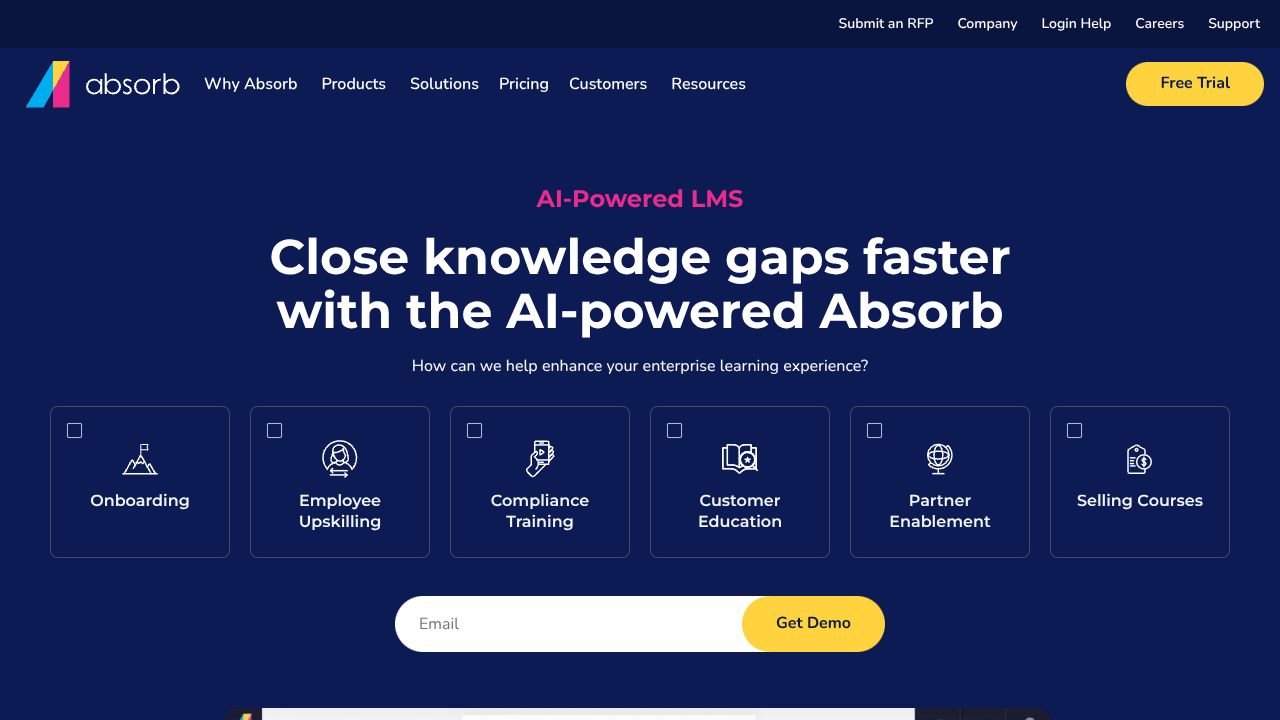
Employees spend an estimated 9.3 hours per week searching for information — time that could drive product development or customer outcomes. Absorb LMS is a configurable learning-management platform with AI search, community integration, and mobile-first access designed to unify learning and community content. For startup leaders focused on rapid skill ramp, distributed teams, and measurable ROI, Absorb reduces discovery friction and converts scattered knowledge into repeatable capability.
The Business Case
Absorb's value proposition is operationalizing knowledge discovery at scale. The platform’s AI search links community discussions, course content, and resources into a single discovery layer — a direct lever for reducing time-to-competency and increasing reuse of institutional knowledge. For mid-to-large startups moving from ad hoc training to structured capability-building, the measurable outcomes to track are: time-to-productivity, course completion rates, internal support-ticket deflection, and learner NPS.
From a competitive-advantage perspective, startups that can compress ramp time for sellers, engineers, and customer-success teams convert headcount into revenue faster. Practically, a 10–20% reduction in search and onboarding time (a conservative estimate based on industry pilots) translates into earlier revenue generation and lower hiring needs in early growth phases. The pricing model is custom-by-learner, which supports predictable per-learner ROI analysis but requires scenario planning for headcount growth. Our analysis recommends pilot pilots with experimental measurement (A/B or staggered rollouts) to quantify lift before enterprise-wide commitment.
Key Strategic Benefits
- Operational Efficiency: Absorb’s unified AI search reduces cognitive friction between community threads and formal learning, shortening the time employees spend hunting for answers. That directly improves throughput in customer support and engineering onboarding workflows.
- Cost Impact: By increasing self-service learning and surfacing reusable content, organizations can lower reliance on live training and external vendors; expected savings accrue in reduced trainer hours and lower time-to-billable. Custom pricing requires modelling per-learner spend against productivity gains.
- Scalability: Built for distributed learning communities, Absorb supports mobile access and brand-customizable portals that scale across geographies and business units without fragmenting content. This enables centralized governance with localized delivery as the company expands.
- Risk Factors: Watch for vendor lock-in on proprietary AI indexes, hidden costs in deep integrations, and adoption friction—especially if existing content is poorly tagged. Additionally, custom pricing can create budget volatility unless growth scenarios are stress-tested.
Implementation Considerations
Successful deployments follow a 3-stage, data-driven plan: pilot (4–8 weeks), scale (3–6 months), optimize (ongoing). The pilot should select one measurable use case (sales onboarding or customer support certification), migrate 20–30% of content, and instrument metrics: search time, course completion, support ticket deflection, and learner satisfaction. Integration requirements typically include SSO/identity, HRIS for learner rosters, and API-level access to community platforms (if external). Resource allocation: designate a product owner, LMS admin, a content-engineer, and an executive sponsor to resolve cross-functional blockers.
Change management must emphasize discoverability and taxonomy: AI search depends on content quality and metadata. Plan a content-cleanup sprint (2–4 weeks) and establish tagging standards. A/B testing the new search-driven experience against the legacy portal will produce the clearest causal evidence of impact. Expect initial shadowing and support load as teams adapt; build a 10–15% buffer in training resources for the first quarter post-launch.
Competitive Landscape
Absorb competes with established LMS and learning-experience platforms that emphasize content management, social learning, or enterprise talent management. Compared to systems focused solely on course delivery, Absorb’s differentiator is the AI-powered cross-source search that treats community and formal learning as one discovery surface. For broader market context and comparative vendor reviews, consult industry aggregators such as G2’s Learning Management System category (https://www.g2.com/categories/learning-management-system). Direct platform alternatives include Docebo (https://www.docebo.com) and Cornerstone (https://www.cornerstoneondemand.com), which emphasize talent suite integrations, and Moodle (https://moodle.org) for open-source customization. Use a scorecard that weights: discovery effectiveness, integration depth, mobile experience, analytics maturity, and total cost of ownership when comparing options.
Recommendation
Run a focused 6–8 week pilot of Absorb targeting one high-value cohort (sales or CS) with clear KPIs: reduce onboarding time, increase first-month productivity, and improve learner NPS. Instrument search analytics and support-ticket metrics, and require vendor-provided ROI scenarios tied to your learner growth projections before committing to enterprise terms. This Angle Analysis will give leadership Spectrum Coverage across operational, financial, and founder perspectives — and produce the ecosystem view needed to scale learning as a strategic asset.
INTERESTED IN
ABSORB LMS?